
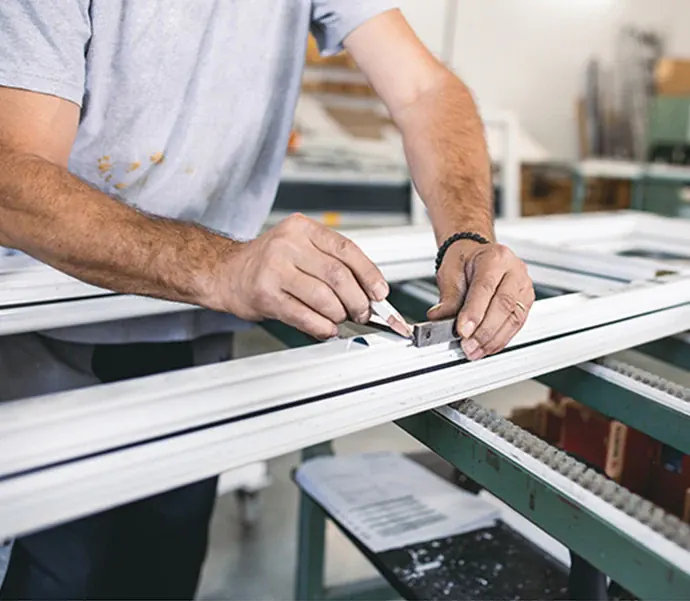
A sliding window that has become stiff is almost never a problem with the profile. It is the roller — either the wrong type was fitted, or the right type was fitted in the wrong weight class. Getting this decision right at the fabrication stage costs nothing; getting it wrong costs a site visit.
Groove or flat?
This is decided by the track, not by preference. A grooved track needs a grooved roller so the wheel is captured and the sash cannot lift out under wind load. A flat track takes a flat roller. Mixing the two produces a sash that rides high, rattles, and wears the track edge away.
Nylon or ball bearing?
Nylon rollers run quietly and cost less, and on a domestic window up to about 25 kg of sash weight they last well. Once the sash carries thicker glass or a larger span, a 12 mm ball bearing roller is the honest choice: the bearing carries the load rather than the wheel face deforming under it.
Single or double?
Count the glass. Single-glazed domestic sashes are fine on single rollers at each corner. Double-glazed units, and anything over roughly 1.5 m in width, should sit on double rollers so the load is spread across two contact points and the sash stays square.
The mistake we see most often
Specifying by price across an entire project. The bathroom window and the living room slider do not carry the same weight and should not carry the same roller. Splitting the schedule by sash weight adds very little to the material cost and removes most callbacks.
If you are unsure which weight class you are in, send us the sash dimensions and the glass specification and we will tell you what to fit.